
From MS-DOS to an API. Under 0.3 seconds. Without flying to China.
At a garment factory of one of our Chinese partners, an MS-DOS machine is the heart of an old production line, and nobody may touch it. It still had to be connected to the CRM through an API, with responses under 0.3 seconds, without stopping the production line. We did it, entirely remotely.
Got a machine nobody may touch? Let's talk
A small company, with 70,000 employees
One of our Chinese partners, a small company with a mere 70,000 employees, came to us with a rather unusual idea. They wanted to connect their CRM to one of their garment factories, through an API.
That alone would have been fine. Except that the factory, for reasons nobody could quite explain, runs on an MS-DOS based system. It was already considered old twenty years ago. And nobody may touch it, because it is the heart of the older production line there.
The job in three lines
- From MS-DOS to an API. The old system’s data has to reach the CRM through a modern API.
- Under 0.3 seconds. That is how fast the API has to respond.
- Nothing may stop. The production line keeps running throughout.
And one extra twist: we could not travel to China. Everything had to be done remotely.
Exactly the kind of job we love.
What we built
We did not replace the old machine, and we did not touch its software. We built around it:
- A local network at the factory. Several modern servers were installed on site, next to the production line, under our remote direction.
- We read the old machine passively. With a tap cable and a VGA splitter, with no software intervention: the MS-DOS system notices nothing, and the production line keeps running undisturbed.
- Conversion in several stages. The old system’s data is converted step by step into a form a modern system understands.
- An API running on site. The API runs right there at the factory, on the modern servers, and serves the CRM from there.
So responses stay under 0.3 seconds.
And the downtime?
Fitting a tap cable or a VGA splitter means unplugging the connector for a moment. We did these cable swaps and restarts in short windows, typically at shift changes. All of it together came to 5 minutes of downtime at most, and the production line never had to stop for it.
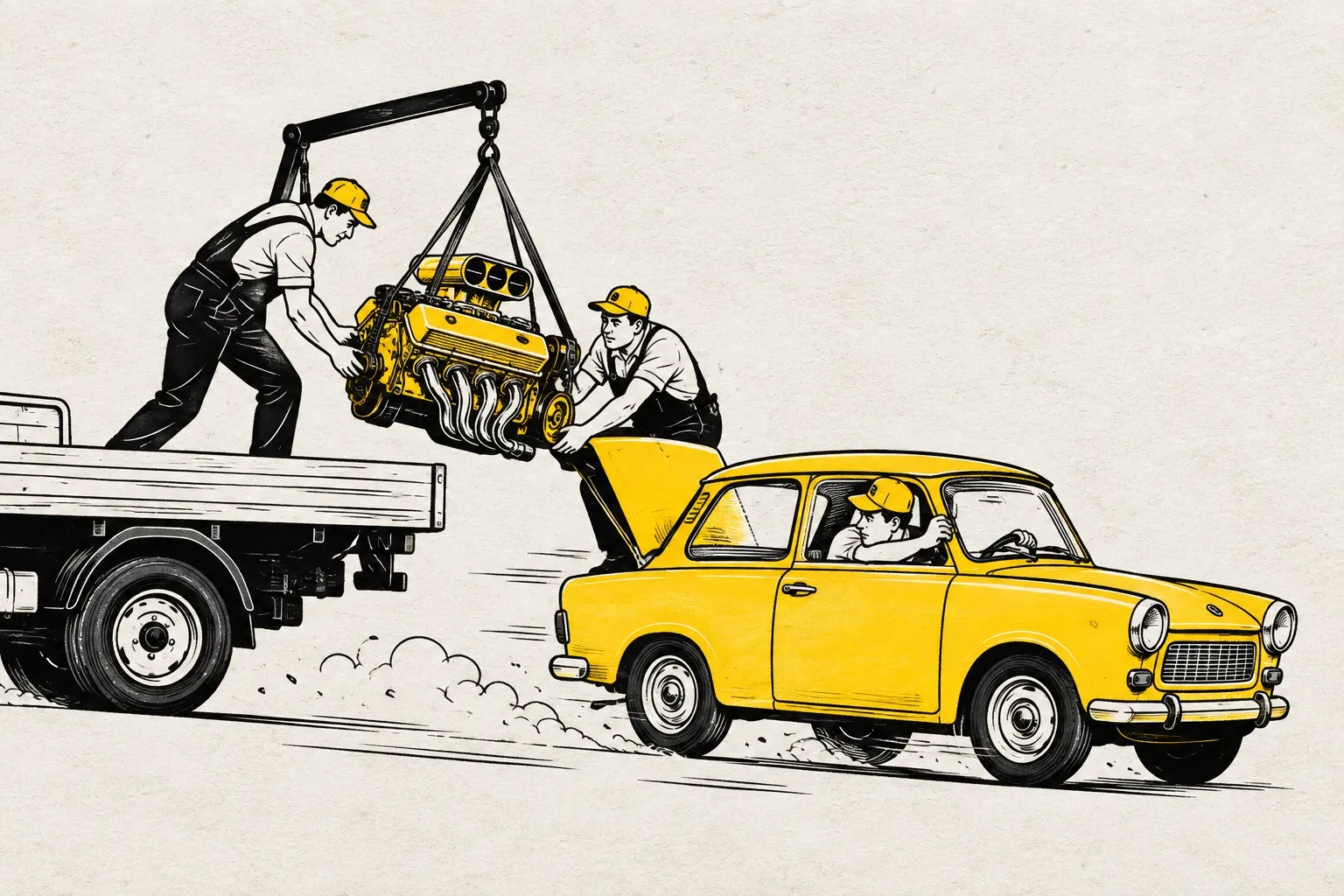
It was like fitting a Ferrari engine into a Trabant while it was racing down the road.
What is worth remembering
- What works does not have to be thrown out. An old system can be connected to the modern world if you build around it, not instead of it.
- The old machine is the most important player. Every step has to be designed so that it notices nothing.
- Distance is not an obstacle. With the right plan, our heads guide the hands of the colleagues on site.
- Speed is also about proximity. When the API runs where the data is created, the answer takes tenths of a second.
Which system at your company does nobody dare to touch?
We love those. How can we help? We reply within one business day.